近日,全國人大代表,國際經濟學會會士,遼寧大學黨委副書記、校長余淼杰接受CGTN采訪,現將原文轉載如下:
Trade tensions are a major topic of discussion among deputies at the ongoing session of China’s top legislature.
Some suggest that the experience gained from managing economic pressures has better equipped domestic enterprises to navigate new challenges.
Global economic uncertainty is intensifying, especially in the wake of new U.S. tariffs on imports from China and other countries.
Despite the pressure, some Chinese industries continue to thrive, boosting confidence across the business sector.
A prime example is the photovoltaic industry.
Tongwei Group Chairman Liu Hanyuan says two decades of sustained development has made the industry strong enough to withstand U.S. tariffs.
“We seldom talk about U.S. tariffs because they don’t impact us enough to matter. Consider this: last year, China installed 278 gigawatts of solar capacity, while the U.S. installed just over 30—only a fraction of ours. We respect the U.S.'s global position, but their competition no longer affects us.”
Despite over a decade of U.S. tariffs on Chinese solar imports, China’s share in global shipments has surged from less than 1% to over 85%.
Liu argues that while the U.S. is using tariffs to support its domestic industry, it cannot impede the broader global energy transition.
“We understand that the US is trying to get their photovoltaic industry some space to breathe and grow by raising tariffs. But the global shift toward clean energy is unstoppable, and we are already ahead—so there’s nothing to fear.”
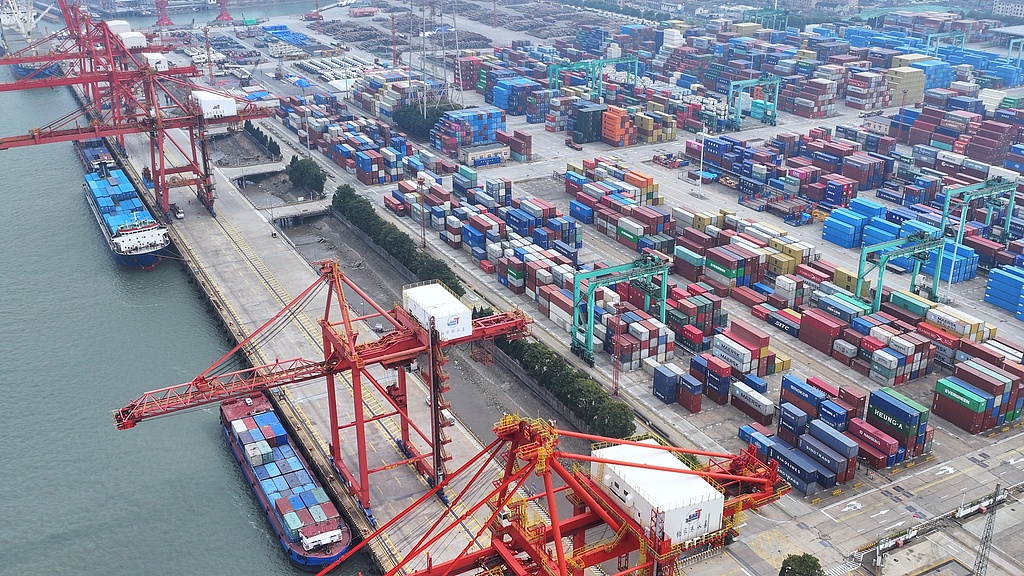
Zhangjiagang Port in eastern China’s Jiangsu Province was busy with constant flow of vehicles and crane operations on March 6th, 2025. [Photo: VCG]
Beyond solar products, the U.S. has expanded tariffs to all Chinese imports, adding another 10% this week on top of the increase implemented in February.
Economist Yu Miaojie warns that these tariffs will ultimately backfire on the U.S. economy.
“Since China buy upstream products from the U.S., which are then processed and exported, these tariffs will inevitably disrupt the US's own exports as well. The U.S. industrial chain is incomplete, and it is impossible to establish a fully self-sufficient supply chain in the short term.”
He also emphasized that China’s countermeasures, including retaliatory tariffs, will be effective in pushing for an end to the trade war.
Beyond direct counteractions, Yu urged businesses to actively diversify their markets.
“It’s crucial to expand export destinations beyond mature economies like the U.S. and Europe. Companies should proactively explore opportunities in the Global South, BRICS nations, and other emerging markets.”
While seeking new trade partners, he stressed the importance of strengthening internal capabilities.
“Businesses must focus on boosting productivity, further reducing costs, and enhancing product quality to improve their international competitiveness.”
Experts agree that challenges persist—not only from the U.S. but also from economies promoting de-globalization. These challenges come not just in the form of tariffs but also through regional conflicts and the weaponization of trade standards.
As China navigates these hurdles, it is defining its own trajectory toward continued growth and leadership--shifting to high-end manufacturing and expanding international collaboration.
崇山校區:沈陽市皇姑區崇山中路66號 郵編:110036
蒲河校區:沈陽市沈北新區道義南大街58號 郵編:110136
武圣校區:遼陽市白塔區青年大街38號 郵編:111000
聯系方式:024-62202013
中國沈陽 遼寧 大學 Copyright by 遼寧大學 2016 遼ICP備05001361號
崇山校區:沈陽市皇姑區崇山中路66號
郵編:110036
蒲河校區:沈陽市沈北新區道義南大街58號
郵編:110136
武圣校區:遼陽市白塔區青年大街38號
郵編:111000
聯系方式:024-62202013
中國沈陽 遼寧大學 遼ICP備05001361號